
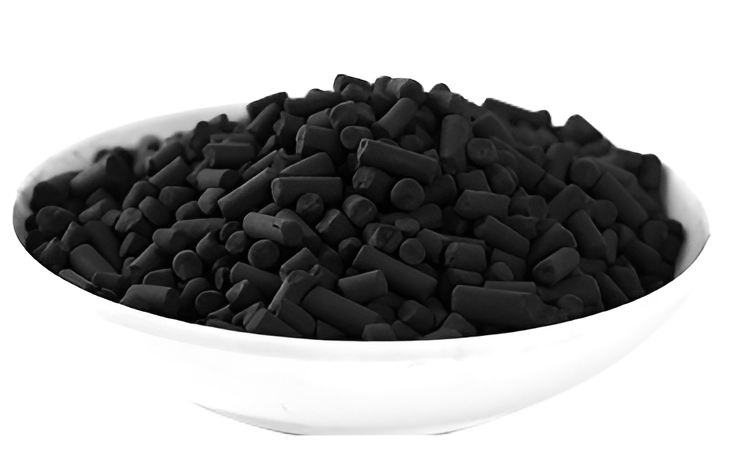
Pellets Activated Carbon
Pelletized Activated Carbon (PAC) is a specialized form of activated carbon manufactured by extruding activated carbon into cylindrical-shaped pellets with diameters of 3mm, 4mm, 5mm, and 8mm. Produced through high-temperature steam activation and combined with suitable binders under strict quality control, these pellets are engineered to deliver exceptional adsorption capacity, high mechanical strength, and chemical stability. Their low ash content, extended pore volume, and large surface area make them highly efficient in removing a wide variety of contaminants from air, water, and gas streams. Pelletized Activated Carbon is widely used in applications such as removing volatile organic compounds (VOCs), mercury, and other hazardous pollutants from natural gas, as well as in odor control systems, solvent recovery, and evaporative emissions control. The cylindrical shape ensures a low-pressure drop, excellent hardness, and long service life, making it a preferred choice for vapor-phase adsorption systems. By varying manufacturing conditions, the internal pore structure can be tailored to impart unique adsorption properties specific to each application. This versatility allows PAC to be applied across multiple industries, including thermal power plants, steel plants, non-ferrous metal smelting, fuel and gas processing, coal furnaces, ammonia production, and municipal waste incineration units. It is especially effective for desulfurization and denitrification of industrial flue gases, contributing to cleaner air and environmental compliance.
Applications Of Pellets Activated Carbon
Pelletized Activated Carbon is extensively used across industries due to its high adsorption capacity, uniform structure, and long service life. In the environmental sector, it plays a vital role in air purification, odor control, and removal of volatile organic compounds (VOCs) from industrial exhausts and indoor air systems. In the energy and power sector, PAC is widely applied for flue gas treatment, desulfurization, and denitrification in thermal power plants, steel plants, and non-ferrous metal smelting units, helping industries meet stringent emission norms. It is also effective in natural gas purification, where it removes mercury, hydrocarbons, and other harmful contaminants. Additionally, PAC is used in solvent recovery systems, evaporative emissions control, fuel gas purification, ammonia plants, and waste incineration units. Its high durability, customizable pore structure, and excellent adsorption efficiency make it a preferred choice for industrial gas treatment, chemical processing, and environmental protection applications worldwide.

Features Of Pellets Activated Carbon
- Cylindrical Pellet Form – Manufactured in uniform sizes (3mm, 4mm, 5mm, and 8mm) for consistent performance.
- High Mechanical Strength – Resistant to breakage and abrasion, ensuring durability during use.
- Low Ash Content – Provides high purity and efficiency with minimal impurities.
- Large Surface Area & High Adsorption Capacity – Ensures maximum contaminant removal across air, gas, and vapor streams.
- Extended Pore Volume – Well-developed pore structure ideal for adsorption of both large and small molecules.
- Excellent Chemical Stability – Suitable for harsh industrial environments without losing efficiency.
- Low Pressure Drop – Allows high adsorption efficiency while maintaining smooth air/gas flow.
- Wide Industrial Applications – Effective in gas purification, solvent recovery, VOC removal, flue gas treatment, and emission control.
- Steam Activated under Strict Quality Control – Ensures consistent performance and reliable results.
- Customizable Adsorption Properties – Tailored during manufacturing to meet specific industrial needs.
| Properties | RCC-500 | RCC-600 | RCC-700 | RCC-800 | RCC-900 | RCC-1000 | |
|---|---|---|---|---|---|---|---|
| Diameter | mm | 3,4,5 & 8mm | |||||
| lodine Adsorption | min. mg/gm | 500 | 600 | 700 | 800 | 900 | 1000 |
| Ash Content | %max | 8-10 | 8-10 | 8-10 | 8-10 | 8-10 | 8-10 |
| Moisture | %max | 5 | 5 | 5 | 5 | 5 | 5 |
| Bulk Density | gm./cc | 0.5-0.6 | 0.5-0.6 | 0.5-0.6 | 0.5-0.6 | 0.5-0.6 | 0.5-0.6 |
| Hardness | min | 95 | 95 | 95 | 95 | 95 | 95 |
| CTC Adsorption | min | - | - | - | 35-40 | 40-45 | 50-55 |